Drum Programming That Sounds Like a Drummer Played It
Good drum programming fools the ear into hearing a person. This guide covers six techniques that get you there, each with a grid you can play, then the MIDI map you need to take the drums into a DAW.
- Updated Nov 21, 2026
- 10 min read
Drum programming is writing drum parts note by note in a drum machine, step sequencer or DAW: which drum plays, when, and how hard. To make it sound human, write only what four limbs could play, use ghost notes and accents, add swing, and put fills where phrases end.
Drum programming: think in limbs, not in boxes
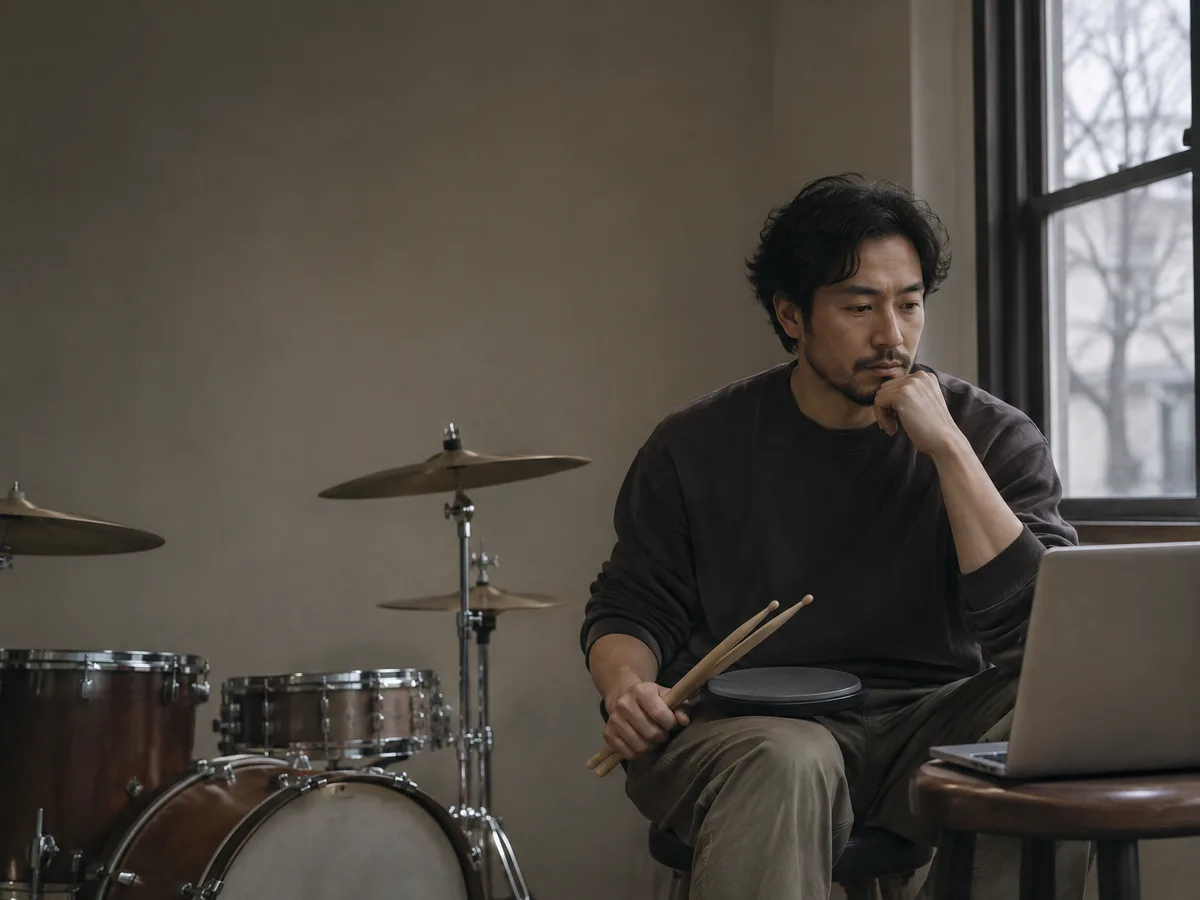
A grid lets you put any drum on any step. A drummer has two hands and two feet. Most programmed beats that sound fake break that limit without anyone noticing why.
So picture the kit while you click. If you do not know every piece by name yet, here is what each drum and cymbal in a kit is called.
The groove below is a funk bar at 100 BPM: syncopated kick, ghost notes on the snare, sixteenth hats. Every note in it is playable by one drummer.
| Kick | ||||||||||||||||
|---|---|---|---|---|---|---|---|---|---|---|---|---|---|---|---|---|
| Snare | ||||||||||||||||
| Closed hat |
- Kick Right foot: 1, the & of 1, the a of 2 and the & of 3.
- Snare Left hand: 2 and 4 loud, three ghost notes around them.
- Closed hat Right hand: all sixteen steps, no gaps.
Can a drummer play it?
- Two hands, two feet: at most four sounds on any one step.
- The right foot plays the kick; the left foot opens and closes the hi-hat.
- A hand playing the hats cannot also hit the snare or a tom on the same step.
- Fast tom runs take both hands, so the hats stop during a fill.
01Technique 1: the four limb rule
In this bar the hats, snare and tom all land on steps 5 and 13: three hands. It sounds busy and flat, because nothing about it could happen on a real kit.
Move the tom one step later, onto the e, and hear the playable version. Same parts, and suddenly it sounds like a pickup instead of a pile.
| Kick | ||||||||||||||||
|---|---|---|---|---|---|---|---|---|---|---|---|---|---|---|---|---|
| Snare | ||||||||||||||||
| Closed hat | ||||||||||||||||
| Tom |
Velocity and ghost notes when programming drums on a step grid
Velocity is how hard a note is hit. The drum machine has three states per step: empty, a full hit, and a ghost note at about half volume (Shift-click). That is enough for most accents.
Ghost notes are the quiet strokes between the loud ones. On a snare they add drag; on hats they make a steady line breathe.
In drum programming, the gap between loud and quiet matters more than the exact numbers. Keep the backbeat loud and everything around it softer, and the groove has a shape.
02Technique 2: accents in the hats
Write sixteenth hats with only the first of each four loud and the other three as ghost notes. The pulse on each beat stands out, the way a drummer leans on the downbeat.
Now compare the same hats all at full volume: that is the machine gun sound programmed drums are known for.
| Kick | ||||||||||||||||
|---|---|---|---|---|---|---|---|---|---|---|---|---|---|---|---|---|
| Snare | ||||||||||||||||
| Closed hat |
03Technique 3: open hat, then closed
Put an open hat on step 7 and a closed hat on step 8. A drummer opens the hi-hat with the left foot and snaps it shut on the next note, so the open sound is short and the closed one follows it.
The drum machine does not cut the open tail for you; the closed hat right after it masks most of it. In a DAW, put both hats in one choke group for the real effect.
| Kick | ||||||||||||||||
|---|---|---|---|---|---|---|---|---|---|---|---|---|---|---|---|---|
| Snare | ||||||||||||||||
| Closed hat | ||||||||||||||||
| Open hat |
Fills and variation when programming drum machine patterns
A loop that never changes is the clearest sign of programmed drums. A drum fill at the end of a phrase, and small changes from bar to bar, fix most of that.
04Technique 4: a fill every 4 or 8 bars
This is bar B of the Rock groove: the hats stop and four toms run through the last beat. Put it on the fourth or eighth bar of a phrase, never every bar.
The hats stop because the hand that played them is now on the toms; the limb rule again.
| Kick | ||||||||||||||||
|---|---|---|---|---|---|---|---|---|---|---|---|---|---|---|---|---|
| Snare | ||||||||||||||||
| Closed hat | ||||||||||||||||
| Tom |
05Technique 5: copy A to B, change two boxes
Copy A to B and change exactly two things: here, an extra kick on step 14 and a loud snare on step 15. Loop A then B and the two bars feel like one player, not two loops.
Change more than three or four boxes and B starts to sound like a different song.
This habit is most of what makes drum programming sound like a band: the same player, making small decisions every few bars, instead of one perfect loop pasted end to end.
| Kick | ||||||||||||||||
|---|---|---|---|---|---|---|---|---|---|---|---|---|---|---|---|---|
| Snare | ||||||||||||||||
| Closed hat |
Swing in drum programming: where it pushes each note
Swing delays every second sixteenth note, the e and the a of each beat, while the beats and the ands stay put. At 100 on the slider that delay is about a third of a step.
06Technique 6: small swing amounts
This breakbeat plays with Swing at 10: barely there, more of a lean than a shuffle. Then play the same bar at 30 and listen to the ghost notes start to bounce.
Swing only touches notes on the e and a. A pattern with nothing there sounds the same at any swing setting.
Good drum programming uses swing like salt. Set it while the whole beat plays, not while one row is soloed, and stop at the first amount that feels right.
| Kick | ||||||||||||||||
|---|---|---|---|---|---|---|---|---|---|---|---|---|---|---|---|---|
| Snare | ||||||||||||||||
| Closed hat | ||||||||||||||||
| Open hat |
MIDI drum programming: note numbers and moving to a DAW
The grid has three volumes per step and no note length or timing offset. For finer drum programming, Download MIDI and keep working in a DAW, where every note has its own velocity and position.
The file uses the General MIDI drum map, so a GM kit in any DAW plays the right drums straight away. Hits export at velocity 110, ghost notes at 55, and muted rows are left out.
| Row | MIDI note | Channel |
|---|---|---|
| Kick | 36 | 10 |
| Rim | 37 | 10 |
| Snare | 38 | 10 |
| Clap | 39 | 10 |
| Closed hat | 42 | 10 |
| Tom | 45 | 10 |
| Open hat | 46 | 10 |
| Cowbell | 56 | 10 |
| 808 bass | 31 (G1) | 1 |
The 808 bass goes to channel 1 as a single note, so put a bass instrument on its own track. The machine does not take input from a MIDI controller or pads; drum programming there happens with the mouse, a finger or the keyboard.
Advanced drum beat programming: one groove at three levels
The same hip hop bar, three ways. Each level keeps everything from the one before and adds one or two of the techniques above.
- 01
Basic
Kick, snare on 2 and 4, eighth hats.
90 BPMKick Snare Closed hat - 02
Ghosts and an open hat
Ghost snares on the a of 2 and 4, an open hat at the end.
90 BPMKick Snare Closed hat Open hat - 03
Fill and syncopated kick
Extra kicks on the & of 1 and the e of 4, toms through the last beat.
90 BPMKick Snare Closed hat Tom
When a part still sounds programmed, look it up on the left and try the change on the right.
- Machine gun hatsTurn three of every four hats into ghost notes.
- A fill in every barKeep fills for bar 4 or bar 8 of the phrase.
- Ghost snares as loud as the backbeatUse Shift-click ghosts, or lower their velocity in the DAW.
- The groove sounds drunkPull the swing back until the snare stops feeling late.
- The kick fights the vocalRemove kicks that land on the singer’s strongest words.
- Different drums in the DAWLoad a General MIDI kit or remap notes with the table above.
The funk groove from the top of the page with a B bar from technique 5. Open it and keep programming.
Open in the drum machine| Kick | ||||||||||||||||
|---|---|---|---|---|---|---|---|---|---|---|---|---|---|---|---|---|
| Snare | ||||||||||||||||
| Closed hat |
All of this runs in the step sequencer that runs in the browser. If any step above felt too fast, go back to how to make a beat from scratch and rebuild a plain groove first.
Drum programming questions
Step sequencer or piano roll: which is better for programming drums?
A step sequencer is faster for writing a groove because every position is a box. A piano roll is better for detail: exact velocity, note length and timing off the grid.
How do I make MIDI drums sound less stiff?
Vary velocity, add ghost notes, use a little swing and leave out hits a drummer could not play. In a DAW, nudging a few notes a few milliseconds late also helps.
Do I need to play drums to program them?
No, but it helps to watch drummers and to tap patterns on a table. Knowing which hand plays what keeps your patterns believable.
Should I quantize everything?
Quantize the kick and snare, then leave hats and ghost notes slightly loose or swung. Fully quantized drums are a style choice, common in trap and house.
The MIDI from the drum machine plays the wrong sounds in my DAW. Why?
The export uses the General MIDI drum map on channel 10. Load a GM drum kit, or remap the notes in your drum sampler using the table on this page.
How do I learn other people’s drum patterns?
Loop four bars of a song, count 1 e and a out loud, and write one instrument at a time on the grid: kick first, then snare, then hats.