How to Find the Key of a Song, Starting from the Note It Rests On
Find the home note first, decide between major and minor second, and ask a tool to confirm last. That order works with or without an instrument, and it tells you what to do when a detector and your ears disagree.
- Updated Nov 22, 2026
- 8 min read
How to find the key of a song: hum along until you hit the note the melody keeps settling on. That note is the tonic. Then judge the overall color, bright for major or dark for minor; tonic plus major or minor is the key, and a key finder can check it from an audio file.
How to find the key of a song with no instrument, only your voice

Every key has two parts: a home note, called the tonic, and a scale built on top of it, nearly always major or minor. The four steps below pin down those two parts in order. If the idea is still fuzzy, read what a key in music is first and come back.
Your voice handles the first part. A melody leans toward its tonic the way a sentence leans toward its full stop, and you can feel that lean long before you know any note names.
This guide has no drum grids, unlike our other guides. Drums have no fixed pitch, so a beat on its own carries no key; the clues are in the singing, the chords and the bass.
01Hum the note the song wants to stop on
Play the chorus, pause at a random point and hum the note that would make the line feel finished. Most listeners find the same note within two or three tries.
Now hold that note while the track plays again. If it sits under the whole chorus without rubbing, you have the tonic; if it clashes with several chords, move one step up or down and try again.
To give it a name, match the hummed pitch on a piano app or a tuner app that shows note names, and write it down.
How to tell what key a song is in from its last chord
Songs like to end where they began. In most pop, rock, R&B and hip hop, the final chord, and the chord each chorus lands on, is the tonic chord.
02Compare the last chord with the first
Skip to the closing seconds and listen to the final chord. If its lowest note agrees with the note you hummed, that is strong evidence, and when the opening chord matches as well you can be fairly sure.
Fade-outs and loops that never resolve hide this clue. Listen instead to where each section settles just before the next one starts.
03Line the melody up against a scale
List the melody pitches one by one. A major scale steps whole, whole, half, whole, whole, whole, half from the tonic; natural minor steps whole, half, whole, whole, half, whole, whole.
When every note fits the scale on your tonic, the key is confirmed. One or two outside notes are normal, a borrowed chord or a blue note; a whole section outside it usually means the song has changed key.
Major or minor: find the key a song is really in, not its relative
Every major key shares all seven notes with one minor key, its relative minor, which starts three half steps lower. C major and A minor use exactly the same white piano keys, so the notes alone cannot separate them.
The home note does. A song that rests on C and sounds open is in C major; one that rests on A and sounds heavier is in A minor, with not a single note changed.
This pair is the most common reason a person and a detector disagree. The table lists all twelve pairs, their Camelot codes, the sharps or flats in their key signature, and how the key finder spells them.
| Major key | Relative minor | Camelot | Signature | Key finder shows |
|---|---|---|---|---|
| C | A minor | 8B / 8A | None | C, Am |
| G | E minor | 9B / 9A | 1 sharp | G, Em |
| D | B minor | 10B / 10A | 2 sharps | D, Bm |
| A | F# minor | 11B / 11A | 3 sharps | A, F#m |
| E | C# minor | 12B / 12A | 4 sharps | E, C#m |
| B | G# minor | 1B / 1A | 5 sharps | B, G#m |
| F# or Gb | D# or Eb minor | 2B / 2A | 6 sharps or 6 flats | F#, D#m |
| Db | Bb minor | 3B / 3A | 5 flats | C#, A#m |
| Ab | F minor | 4B / 4A | 4 flats | G#, Fm |
| Eb | C minor | 5B / 5A | 3 flats | D#, Cm |
| Bb | G minor | 6B / 6A | 2 flats | A#, Gm |
| F | D minor | 7B / 7A | 1 flat | F, Dm |
Parallel keys are the other pair worth knowing. C major and C minor share a tonic but not their notes, so a switch between them keeps the same home and changes only the mood, a favorite move for a final chorus.
How do you know what key a song is in when a tool disagrees
A detector listens to the whole file, adds up how much of each of the twelve notes it hears, and picks the major or minor key whose profile fits best. It is quick and usually close, but it stays an estimate.
04Check your answer with a detector
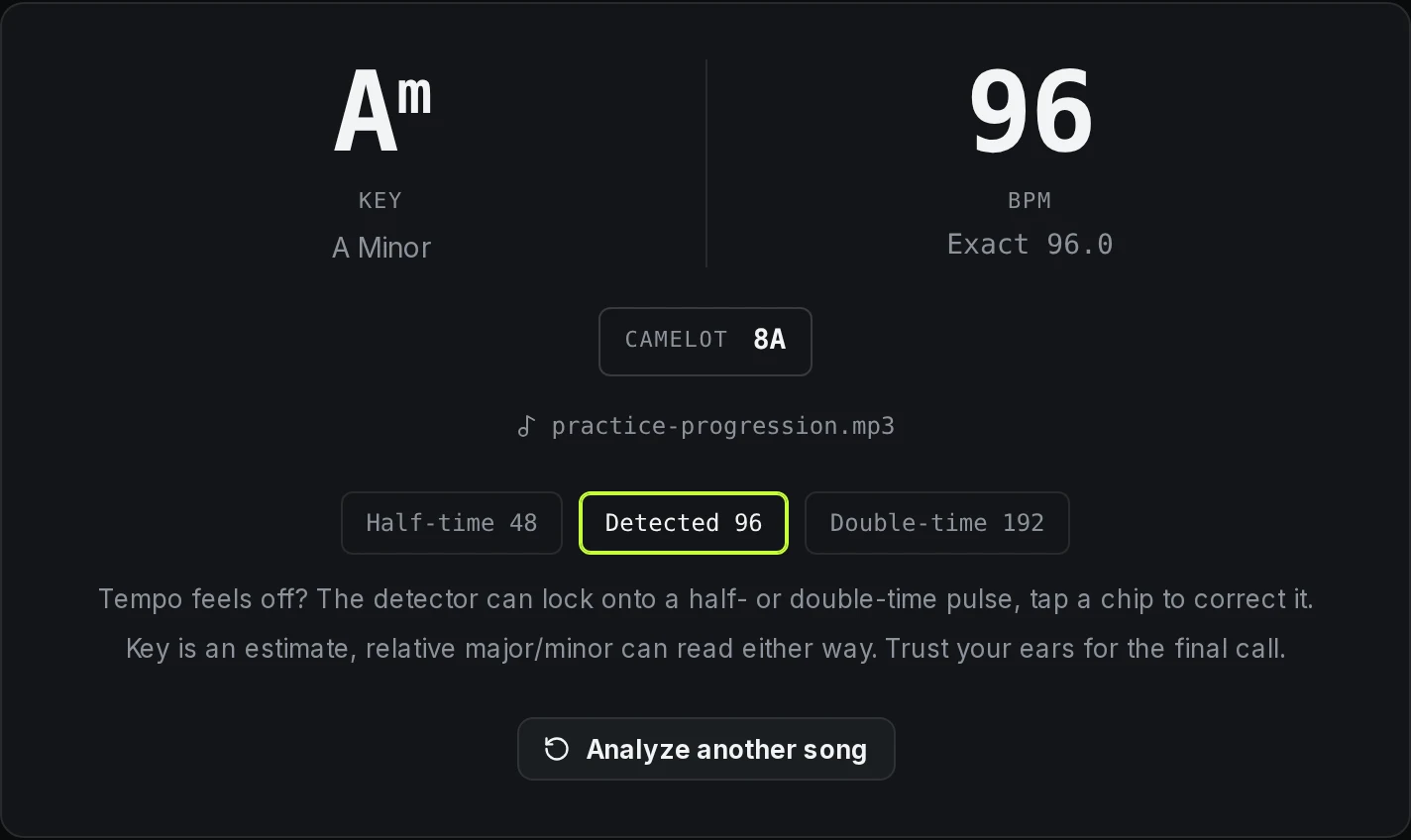
Drop an audio file into the song key detector; it takes MP3, WAV, M4A, FLAC or OGG, depending on what your browser can decode. The analysis runs on your device, and the card shows the key, its Camelot code and the tempo.
The file in this shot is a 20 second A minor loop we synthesized for the test: Am, Dm, E, Am at 96 BPM. The tool read it as A minor, 8A, 96 BPM, which is what we wrote.
The same card reads tempo with half-time and double-time chips; counting the tempo of any track explains when to pick each one.
When the result and your ear part ways, do not overwrite your ear at once. Find the symptom on the left and check the note on the right.
- C major, but the song feels like A minorSame notes, different home. Hum the tonic again; if it is A, go with A minor. Relative keys share a Camelot number, 8B and 8A.
- A key that fits only half the songThe song modulates. The detector gives one key per file, so cut the sections apart and test each, or trust your ear for the bridge.
- Minor, yet some passages sound brightIt may be modal. Dorian is minor with a raised sixth and mixolydian is major with a lowered seventh; keep your tonic and call them minor and major.
- A key a half step away from where you play alongOld records and tape transfers often run slightly sharp or flat. Retune your instrument to the record, or test both neighbors and keep the one that sits.
- A strange key on a sparse trap songDrums, an 808 and a short melody give little harmony to read. Hum with the 808 notes; the one the loop returns to is usually the tonic.
One spelling quirk: the result names flat keys with sharps, so A# is the same key as Bb, and D#m the same as Ebm.
Got an MP3 or WAV of the song? One pass gives its key, Camelot code and BPM, with nothing uploaded and no account.
Open the key finder
Find a song's key as a Camelot code for mixing two songs
DJs and producers often care less about the name of a key than about whether two tracks will sit together. The Camelot wheel turns that into numbers: twelve positions, A for minor and B for major.
Two tracks blend cleanly when they share a code, sit one number apart (8A beside 7A or 9A), or swap letters on the same number (8A with 8B, a key and its relative). Jumps of two numbers or more are where clashes begin.
The code also helps when you build a beat for a song you love: choose its key or a neighbor, then write chords in it. If the original sits too high or low for a singer, moving a track up or down a few semitones is the next step.
Drums need no key, so the free beat maker online lets you lay down the groove before any of this is settled, and a step by step walkthrough of building your first beat starts from the kick. Once you know how to find the key of a song by ear, a detector becomes a second opinion rather than the answer.
Eight words for talking about keys
- Tonic
- The home note of a key, where melodies feel finished. It gives the key its letter name.
- Scale
- The seven notes a key uses, in a fixed pattern of whole and half steps from the tonic.
- Key signature
- The sharps or flats written at the start of each staff, shared by a major key and its relative minor.
- Relative minor
- The minor key three half steps below a major tonic, with the same notes: A minor for C major.
- Parallel minor
- The minor key on the same tonic: C minor for C major. Same home, different notes.
- Mode
- A scale started from another degree, such as dorian or mixolydian, with its own color.
- Modulation
- A change of key inside a song, often a step up for the last chorus.
- Camelot code
- A number from 1 to 12 plus A for minor or B for major, used to pick keys that mix well.
Quick answers on how to find the key of a song, from capos to Camelot
Can I work out a song's key without music theory?
Yes. Humming the note a melody settles on and naming it with a piano or tuner app solves most songs. Theory helps mainly with modal songs and key changes.
Does a song ever have more than one key?
A song can change key partway through, often lifting the last chorus by a step. At any one moment there is a single tonic, so name a key per section rather than one for the whole track.
How accurate is a key finder?
Treat it as an estimate. When it misses, it usually lands on the relative major or minor or on a key a fifth away, so hold the result up against your own ear.
The guitarist plays with a capo. Which key is the song in?
Add the capo fret to the chord shapes. G shapes with the capo on the second fret sound as A, so the song is in A even though the hands play G.
How do I use the Camelot code?
Pair tracks that share a code, sit one number apart, or swap the letter on the same number. Those three moves keep most notes in common between the two songs.
I know the key now. How do I make a beat that fits?
Build the drums first at the original tempo, since drums need no key. Then write chords and a bass line from the scale on the tonic you found, starting each loop on that tonic.