Music Production for Beginners: Six Jobs and a First Week Plan
A producer turns an idea into a recording people can play, and that work splits into six jobs. This page on music production for beginners names those jobs, then gives you one small task a day for a week, starting with drums you can hear right here.
- Updated Nov 21, 2026
- 9 min read
Music production is all the work of turning a musical idea into a finished recording you can play to someone: writing it, arranging it into sections, choosing or making the sounds, recording, mixing the parts into balance and mastering the final file. One person can do every job, or a team can share them.
Music production for beginners, in plain words
Most tutorials start with gear and software. That is backwards: the hard part is knowing what each stage is for, so you can tell which one your song is missing.
The good news is that the stages come in a fixed order, and you can learn them one at a time. Drums come first because every other part sits on top of them; that is also why this guide spends three days on rhythm before it opens a DAW.
Expect the first few loops to sound plain. Producers who stick with it are the ones who finish small things often, not the ones who wait until they know everything; a finished rough sketch teaches more than a perfect intro that never gets a verse.
You do not need to be good at all six jobs. Most producers are strong at two or three and lean on habits, templates or other people for the rest.
A useful test for any tutorial you find later: which of the six jobs is it teaching? If you cannot tell, it is probably showing off a plugin, and you can skip it for now. Good music production for beginners keeps one job in focus at a time.
The production of music, split into six jobs

Every finished track went through the same six jobs, whether one person did them in a bedroom or a dozen people did them in a studio. Each job has a clear output you can point to.
When a song feels unfinished, ask which output is missing. A great idea with no arrangement loops forever; a full arrangement with a poor mix sounds crowded even when the parts are good.
Beginners tend to jump to the mix because the knobs look like progress. Writing and arranging move a song further in the first year.
- 01
Write
An idea worth keeping: a hook, a chord loop, a rhythm.
Hum it into your phone voice memo before it is gone.
- 02
Arrange
A map of the song: which part comes when, and for how many bars.
Count bars on paper while you listen to a song you like.
- 03
Sound design
The sounds themselves: which kick, which pad, which bass.
Browse the drum sounds in the beat maker and note what you like.
- 04
Record
Takes of a voice or an instrument.
A phone in a quiet room with soft furniture around you.
- 05
Mix
Balance: every part audible, nothing fighting.
Volume faders in a DAW and one pair of headphones you know well.
- 06
Master
The final file, level matched to other releases.
Compare against a released song in the same style at the same volume.
The MakeBeat drum machine covers a slice of the first three jobs: a rhythm idea, a two bar arrangement and the drum sounds. Recording, mixing and mastering happen elsewhere, which is why the week plan moves to a DAW on day four.
A first week of music production, one small task a day
Thirty minutes a day is enough. The first three days happen in the drum machine and each one has a grid you can play; day four moves the result into a DAW.
01Day 1: build the drums
Load a plain hip hop groove at 90 BPM: kick on steps 1, 8 and 11, snare on 2 and 4, closed hats on every eighth note. Play it, then move one kick and listen to what changes.
Rhythm first, because a melody written over silence rarely fits the drums that arrive later.
Spend the rest of the half hour changing one row at a time and playing it back. You are training your ear, not finishing anything.
| Kick | ||||||||||||||||
|---|---|---|---|---|---|---|---|---|---|---|---|---|---|---|---|---|
| Snare | ||||||||||||||||
| Closed hat |
02Day 2: add a bass that follows the kick
Put the 808 bass on the kick steps, plus one extra hit on step 15 that leads back to the top of the bar. The bass and kick now move together, which is what makes low end sound solid.
Try moving the extra hit to step 14 or 16 and hear how it changes the pull back into bar one. There is no wrong answer, only the one you like.
| Kick | ||||||||||||||||
|---|---|---|---|---|---|---|---|---|---|---|---|---|---|---|---|---|
| Snare | ||||||||||||||||
| Closed hat | ||||||||||||||||
| 808 bass |
03Day 3: make a second bar
Press Copy A to B, edit B so it ends differently (a snare on step 15 and an open hat), then set Loop to A then B. Two bars that answer each other already sound like a phrase instead of a loop.
If you want the reasons behind each hit, read a step by step walkthrough of building your first beat.
| Kick | ||||||||||||||||
|---|---|---|---|---|---|---|---|---|---|---|---|---|---|---|---|---|
| Snare | ||||||||||||||||
| Closed hat | ||||||||||||||||
| Open hat | ||||||||||||||||
| 808 bass |
04Day 4: export MIDI and open it in a DAW
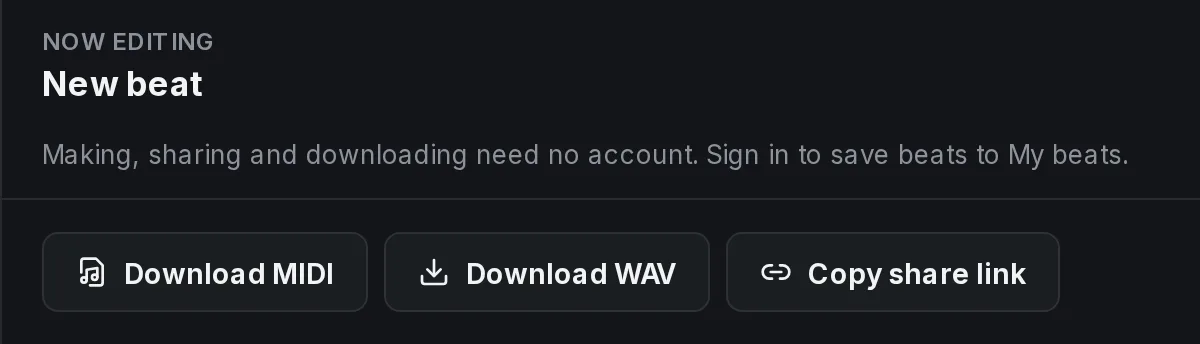
Press Download MIDI and drag the file into your DAW. The notes follow the General MIDI drum map, so any drum instrument in the DAW plays them, and you can swap the whole kit without touching a note.
Keep the WAV too: it is a reference of how the beat sounded before you changed anything.
Most of day four is learning where things are in the DAW: the track list, the timeline, the play button and the export menu.
05Days 5 to 7: chords, melody, a rough mix
Day 5, add four chords on a piano instrument in the DAW, one per bar. Day 6, write a short melody on top using notes from those chords; the theory behind chords, scales and rhythm in beats helps here.
Day 7, balance the volumes so drums, bass and chords are all audible, and export. The grid above is the drum part you built, for reference.
The result will be rough, and that is the point. You will have touched writing, arranging, sound choice and mixing in one week, which is what music production for beginners should feel like: small, finished steps.
| Kick | ||||||||||||||||
|---|---|---|---|---|---|---|---|---|---|---|---|---|---|---|---|---|
| Snare | ||||||||||||||||
| Closed hat | ||||||||||||||||
| 808 bass |

How to produce music for free with what you already own
You can produce music for free with a computer or phone, headphones and free software. For drums, the browser beat maker needs no install or account to make, download or share a beat.
For the DAW, LMMS is free and open source on Windows, macOS and Linux (checked November 2026); GarageBand comes from the App Store if you use a Mac, iPhone or iPad. Pick one and stay with it for a month.
Be clear about what the beat maker does not do: it has drums and a one note 808, no melody, chords or recording, so those parts belong in the DAW.
Skip paid sample packs, plugins and controllers for the first month. They solve problems you do not have yet, and the money is better spent later on the one tool you keep reaching for. Headphones are the only exception if you have none.
Starting kit, nothing to buy
- A computer, or a phone with a current browser.
- Wired headphones: no delay between hitting Play and hearing it.
- One DAW, installed and opened once before day 4.
- A folder for projects, with the date in each file name.
- Thirty minutes on the calendar each day for a week.
Music production words every beginner tutorial assumes
These twelve terms come up in nearly every video and forum thread. A longer list of music production terminology is on its way.
- DAW
- Digital audio workstation: the program where you record, arrange and mix a whole song.
- MIDI
- Note data rather than sound. A MIDI file says which note plays when, and any instrument can play it back.
- Sample
- A short recorded sound, like one kick hit or a slice of an old record.
- Loop
- A short pattern, often one to four bars, that repeats.
- BPM
- How fast the music moves, counted as beats in one minute. A slow hip hop groove sits around 90, a club house track around 124.
- Bar
- One measure of music. In most pop and hip hop a bar holds four beats.
- Stem
- One part of a finished song exported on its own, such as the drums or the vocal.
- Mix
- The balance of all parts, and the finished file that comes out of that work.
- Master
- The last step: the final version of a song, ready to release.
- Gain
- How loud a signal is going into the next stage. Too much gain clips and distorts.
- Plugin
- An effect or instrument that runs inside a DAW, such as an EQ or a synth.
- Export
- Turning your project into a file other people can play: WAV, MP3 or MIDI.
Once the words are familiar, the next thing to learn is the structure of a song: how intros, verses and choruses are laid out in bars.
Ready for day 1? The drum machine opens in your browser, no sign up, with the hip hop groove one click away.
Open the drum machineMusic production for beginners: common questions
Do I need to learn an instrument first?
No. Many producers start with drums on a grid and pick up a little keyboard later. Knowing a few chords helps once you write melodies, but it is not the first step.
How long until I finish my first song?
With the week plan on this page you will have a two bar loop in three days and a rough song sketch by day seven. A song you are proud of usually takes a few more tries.
Is a normal laptop good enough?
Yes, for drums, MIDI and a few tracks of audio. Heavy plugin sessions want more memory later, but nothing in a first project will push an ordinary laptop.
What is the difference between a producer and a beatmaker?
A beatmaker builds the instrumental, drums first. A producer is responsible for the whole record: the beat, the recording, the arrangement and how the final mix sounds.
Do beginners need to learn mixing?
A little, early on: balance levels and keep the kick and bass from clashing. Deeper mixing skills come later, and music production for beginners should not start there.
Can I release music made with free tools?
Yes, as long as the sounds are cleared. Every sound in the MakeBeat drum machine is free to use in your releases; for other packs, read each license.